Uzbekistan’s healthcare system faces pandemic test
In an exclusive interview with Dynamic Uzbekistan, Dr. Ravshan Izamov, Chairman of the National Chamber of Innovative Healthcare of Uzbekistan, spoke about how Uzbek doctors are coping with the pandemic, what impact it has on further modernization of the healthcare system, and the potential for international partnerships in this area.
Dr. Izamov, what sorts of challenges has the healthcare system of Uzbekistan been facing during the pandemic, and how has it adapted to those challenges?
The problems that our healthcare system faces during the COVID-19 pandemic are typical for countries all over the world. This is a multi-fold increase in the burden on hospitals and medical staff, compounded by a lack of treatment methods and preventive measures in the initial phase of a new virus spreading, insufficient quantities of personal protective equipment (PPE), and a number of other challenges.
Uzbekistan gradually introduced restrictive measures aimed at reducing the rate of infection among our population. Let me remind you that the first official case of COVID-19 in Uzbekistan was registered on 15 March. The very next day, the government began to introduce measures such as the requirement to wear masks, keep a social distance, and self-isolated. The suspended public and private transport, closed airports, and introduced other strict lockdown measures.
The specially created interagency commission responded quickly to the situation. A UZS 10 trillion (USD 1.1 billion) Anti-Crisis Fund was created. Huge resources and efforts were devoted to building and equipping special quarantine centers, re-equipping hospitals, purchasing tests and medicines, training medical staff, and creating call centers.
In the first half of 2020, healthcare expenditure in Uzbekistan amounted to USD 841 million—an increase of 22 percent compared to the same period in 2019. Within this budget, USD 23 million were allocated for incentive payments to more than 72,000 medical personnel and sanitation employees. Approximately USD 60 million was spent to create quarantine zones and clinics for the treatment of COVID-19.
Thanks to these decisive actions, the spring wave of coronavirus in Uzbekistan was not as devastating as in many other countries. International experts even began to class Uzbekistan as a success story, as by June 1st there were only 3,700 COVID-19 cases, 80 percent of patients had already recovered, and only 15 people had died.
The authorities began a gradual easing of restrictions and the lockdown was lifted on 15 June, although a number of measures (notably wearing masks and social distancing) were preserved. At the same time, healthcare institutions constantly monitored the epidemic so they could swiftly react to any increase in cases.
Due to this monitoring, quarantine restrictions were re-introduced in Uzbekistan from 10 July, and the summer COVID-19 outbreak proved to be a more serious challenge for the national healthcare system. The infection rate growth exceeded 600 on some days, although this can also be attributed to wider testing.
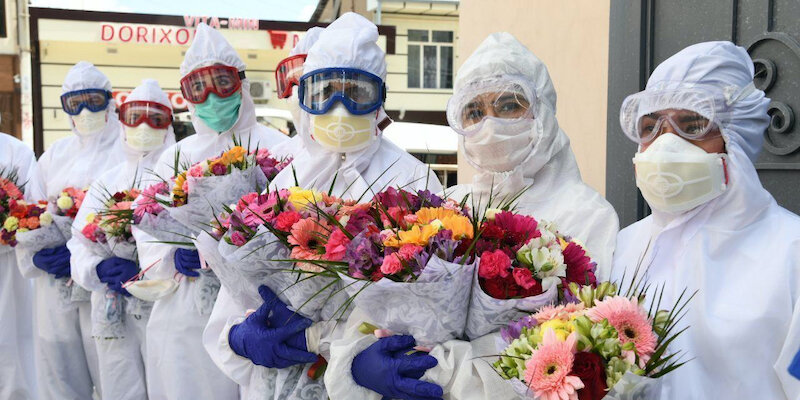
From the outset, the special commission conducted active and transparent communications, explaining and preventing the spread of COVID-19 via various channels, and giving daily press briefings. In July, members of the commission did not hide the fact that with a further rapid increase of cases, hospitals would not have enough beds and doctors. I should mention here, that Uzbekistan's medics took a serious blow and a number of colleagues sacrificed their lives to save patients.
Thanks to strict lockdown and mobilization efforts, the situation was stabilized within a few weeks and the number of COVID-19 cases began to decrease, while the recovery rate again exceeded 80 percent. Therefore, a gradual easing of the lockdown began on 15 August.
The healthcare system of Uzbekistan has experienced a shock transformation, but it has enjoyed the constant support of the government and the population, including volunteers.
The National Chamber of Innovative Healthcare responded sensitively to all the requests that arose during this process. Since the establishment of our chamber, a list of our main tasks included the development of modern clinical guidelines and protocols, quality standards for diagnostics and treatment, and standards for materials and technical equipment, as well as monitoring their implementation.
Our experts are part of a joint working group with the Ministry of Healthcare, which in May 2020 prepared temporary recommendations for the hospital treatment of all patients with COVID-19. This document was updated at the end of June to reflect the new WHO recommendations. At the same time, the chamber produced the temporary clinical guide for home treatment of patients with mild cases of COVID-19.
We are also mastering new techniques and equipment. Since April, the National Chamber and its Chinese partners have been arranging free delivery to Uzbekistan of the sets of devices which proved effective in treatment of severe forms of COVID-19 in Wuhan. In August, together with the Europe-Uzbekistan Association for Economic Cooperation, a private sector body, and with the support of the business community, we facilitated the delivery of 17 new-generation ventilators. All these devices were transferred to local clinics. During the pandemic, the National Chamber also implemented dozens of humanitarian actions for the purchase and delivery of many thousands of sets of PPE to doctors, including in cooperation with the Turkish TIKA Agency.
Of course, there is still a lot to do. However, the experience we gained, and the support from our public and international partners, inspires great hope that Uzbekistan will not only cope with the pandemic, but also use this experience to further modernize our healthcare system.
One of the prerequisites for the decision of the President of Uzbekistan when creating the National Chamber in 2018 was “the search for solutions to those systemic problems that hinder effective healthcare reform.” What are the main problems that you can identify as a priority to solve?
Since its establishment in August 2018, the National Chamber has been working in many areas and implementing a number of projects. For example, work on introduction of the telemedicine was carried out from the first days of the chamber’s existence. In addition, the experience of fighting the COVID-19 pandemic has confirmed the vital need to develop online services in medicine.
The first memorandum in this area was signed in March 2019 with our Indian partners, WatchWitz Technologies and the Kread Foundation. Pilot telemedicine sessions on WatchWitz equipment were held in the regions of Uzbekistan in early April 2020. In the future, we are planning to open a telemedicine training center, and then the National Chamber is going to create similar centers in all regions of the country and train local personnel.
Another step in the development of online medical services will help to improve the accessibility of medical services for hard-of-hearing and deaf people. Since March 2020, in collaboration with our foreign partners Social Unity, we started a pilot project with participation of sign-language translation centers, medical institutions, and municipal authorities in the different provinces of Uzbekistan.
These are just a few examples of the National Chamber’s engagement of international expertise in online health services. As the challenge of COVID-19 has demonstrated, the path of innovation in healthcare is an urgent one. Using online forums, we regularly exchange experience in the fight against COVID-19 with specialists from Canada, Israel, Germany, Belarus, France, the United Kingdom, and Russia. Along with issues of prevention and treatment, we also discuss the digital models for determining the chain of infection, opportunities for online training of doctors, and effective models for getting out of lockdown. The Royal College of Physicians and Surgeons of Canada has already organized six such conferences and webinars.
According to experts, the development of healthcare and pharmaceuticals in Uzbekistan are among the most promising areas for investors and companies wanting to do business in our country. Do you agree with this, and if so, what is the role of the National Chamber in promoting this development?
Providing information support to potential investors is part of the National Chamber’s mandate. This part of our work is focused on partners who are innovating in various areas of healthcare, some of whom are already implementing their models in Uzbekistan. An example of this is Swiss Lab, a network of clinical and diagnostic laboratories based on Swiss technologies, which has been operating in Uzbekistan with our support since last year. In addition to providing high-quality services for the population, Swiss Lab’s work makes it possible for domestic healthcare providers to study in practice how a modern, world-class laboratory system is organized. Swiss Lab was one of the first private laboratories to receive the green-light to provide COVID-19 tests.
The Government of Uzbekistan supports projects to create clinics, laboratories, and other medical facilities, as well as pharmaceutical enterprises based on private capital and public-private partnerships (PPPs). Investors can enjoy a wide range of tax, customs, and other privileges. Foreign companies already operating in our country consider the potential of the medical services market in Uzbekistan to be huge.
You have been a practicing doctor in the UK for many years and know the pros and cons of the Western healthcare system based on your own experience. How does this help you in the context of the National Chamber’s task of modernizing the management of our healthcare system?
Firstly, the National Chamber has fundamental new tasks, such as the creation of a unified register of doctors and pharmacists. This register will be the basis for the next stage, the introduction of a licensing system for healthcare professionals, which does not yet exist in Uzbekistan. These steps are urgently needed and constitute an important part of healthcare management.
The National Chamber prepared a draft resolution of the Cabinet of Ministers concerning the system of registration of doctors and pharmacists. The draft was put forward for public discussion in early 2020. The next stage is the adoption of this act and carrying out specific work to create a unified register for the first time in the country’s healthcare system’s history.
After that, having prepared the ground and analyzed the results, we will proceed to the implementation of the licensing system, which is practiced in advanced countries. To assess the professionalism of doctors/pharmacists, among other things, a modular credit system will be used, which takes into account the healthcare specialist’s continuing professional development (CPD), including taking courses (including by foreign providers) and attending and participating in conferences and seminars.
Based on my own experience in the UK, I can say that licensing is a powerful incentive for the development of healthcare professionals, as well as for providing transparency in their objective assessment. This information is necessary for everyone who is looking for help from a doctor and pharmacist. Such data is also important for investors implementing their projects in Uzbekistan. At the same time, of course, we should not copy, but adapt the best international practices to our conditions and realities.
Photo: Ministry of Health Press Service